Do You Really Need to Connect Your Bank to a Budgeting App?
Automatic transaction tracking is convenient. But is it actually helping you budget better?
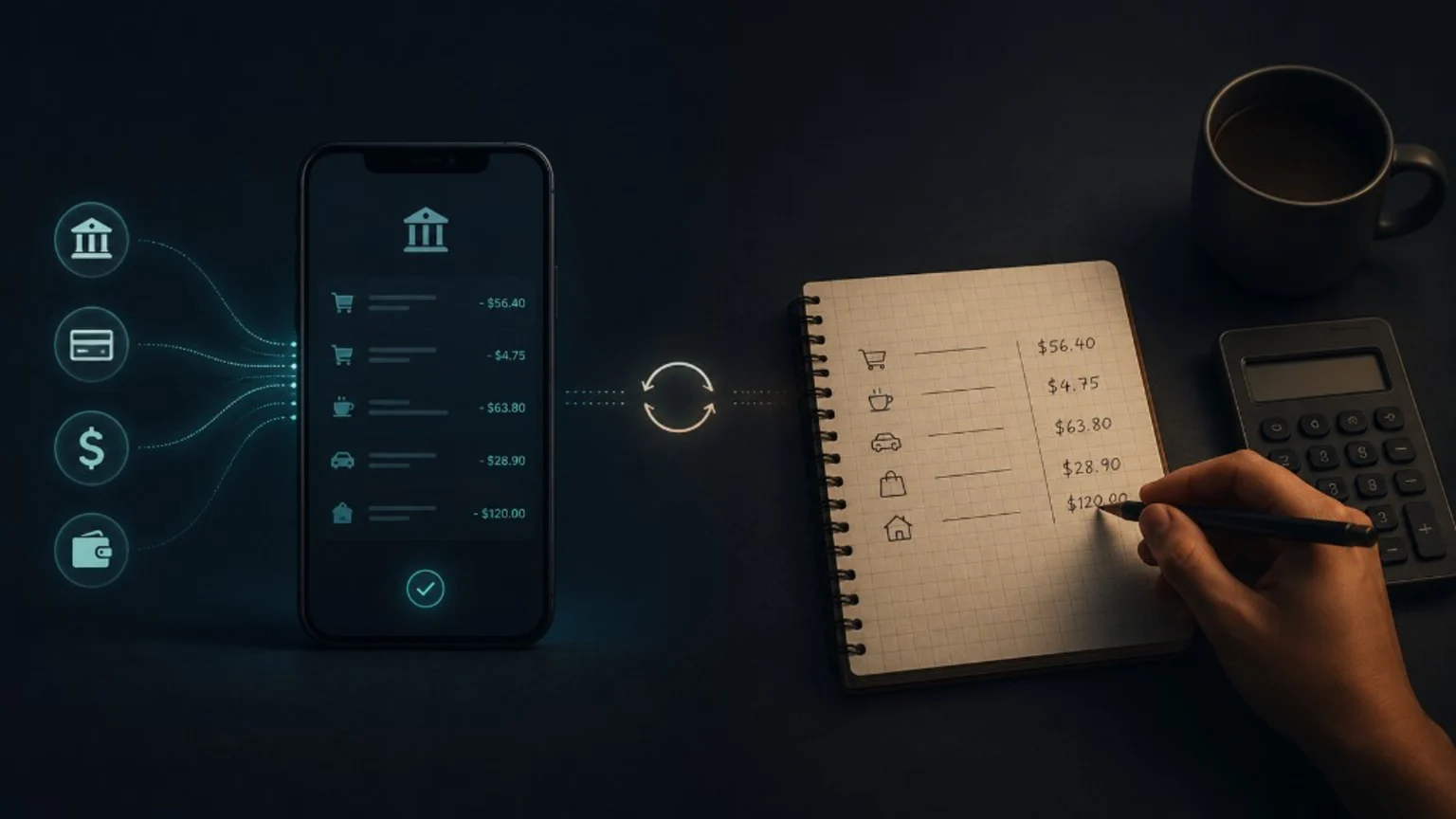
Connecting your bank seems like one of the most obvious features a budgeting app can have.
You connect your accounts once, transactions appear automatically, categories are assigned, and ideally you don’t have to think about any of it again.
It sounds convenient. And it is.
But I’m not sure convenience alone makes it the best way to budget.
People occasionally ask me about bank connections in Budgetum, and every time I think about it I come back to the same question:
Do I actually want my budgeting app to have permanent access to my bank?
And maybe an even more important one:
Does automatically collecting every transaction actually help me understand my money better?
I’m not sure the answer to either question is always yes.
My bank already tracks my spending
Before I started keeping my own budget, I already had analytics in my banking apps.
They showed me things like:
- Supermarkets
- Shopping
- Entertainment
Technically, all the data was there.
The problem was that it didn’t tell me much.
A supermarket purchase could be groceries, household products, something for my child, alcohol, or five completely unrelated things in one receipt.
And seeing that I spent a certain amount on “Shopping” at the end of the month didn’t suddenly make me understand where the money went.
I had the transactions.
I just didn’t have the answers I wanted.
That was one of the reasons I started tracking expenses myself.
I don’t enter every card transaction manually anymore
This part has changed for me.
I used to enter much more manually, but lately I’ve been very busy and I didn’t want budgeting itself to become another job.
So I added a bank statement review flow to Budgetum.
It’s called Match bank statement, and it’s part of Budgetum Pro. I export a CSV or XLSX statement from my bank, and Budgetum lines it up with the transactions I already have in that account.
Now I usually go through my bank transactions about once a week.
It takes around 10 minutes.
That’s enough for me.
Cash is different. I still enter cash expenses immediately because if I don’t, I’ll probably forget them.
So my current system is somewhere in the middle.
I don’t manually type every card purchase.
But I also don’t give an app permanent access to my bank account and let it continuously pull everything in the background.
Once a week I sit down, open the list of transactions from my bank, and quickly go through them one by one.
The key difference is that this isn’t just importing data—it’s a fast review and confirmation step.
Categories and merchants are already suggested automatically, so most of the time I’m just confirming things with a click.
And I’ve realized that I like it this way.
Once a week, we actually look at the budget
Usually my wife and I go through the budget together.
We look at what we’ve already spent, which limits are getting close, where we spent more than expected, and what still has to happen before the end of the month.
Sometimes we adjust something.
Sometimes we just notice that a category is going faster than expected and decide to slow down a little.
And sometimes the original plan was simply wrong.
That happens too.
For me, this is much closer to what budgeting is supposed to be.
Not constantly staring at every transaction.
Not getting a notification every time money leaves an account.
Just regularly looking at the whole picture and making sure we still understand where the month is going.
The bank review flow fits this routine very well.
It saves me from boring data entry without removing the part I care about.
This is the part I’m not sure I want to automate
Let’s say everything is connected automatically.
I spend $35.
The transaction appears.
The merchant is recognized.
The category is guessed correctly.
Maybe the app even shows a nice chart later.
Everything worked perfectly.
But there is also a good chance I never really looked at that $35.
It just became another row in a database.
That’s useful if the goal is accounting.
I’m less convinced it’s always useful if the goal is understanding your spending.
A budgeting app can collect every transaction perfectly while the person using it still reaches the end of the month wondering where the money went.
The goal isn’t necessarily to collect as much financial data as possible. The goal is to understand it.
That’s the difference that interests me.
The privacy tradeoff of connecting your bank
When you connect a bank account to an app, you’re giving another service access to some of the most sensitive data you have.
Not just your current balance.
Potentially your transaction history, merchants, subscriptions, income, transfers, and a pretty detailed picture of how you live.
With a large financial service, you can at least spend some time understanding who operates it, what regulations apply to it, and how it handles security.
But budgeting apps come in every size.
Some are huge companies.
Some are small teams.
Some may effectively be maintained by one or two developers.
As a user, you often have no idea what the infrastructure behind an app really looks like, who can access the data, how long it is retained, what third-party services are involved, or what will happen to that database five years from now.
I’m not saying small developers are untrustworthy.
I’m one myself.
That’s exactly why I think about it.
Running an app is complicated. Companies change. Products get sold. Services shut down. Privacy policies change. Servers get moved. New analytics tools are added.
And financial history is the kind of data that can say a surprising amount about a person:
- Where you shop
- Which doctors or pharmacies you visit
- Where you travel
- What services you pay for
- When your salary arrives
- How much money you have
- Who you send money to
Once you’ve uploaded years of that history somewhere, you can’t really make it private again.
For some people the convenience is absolutely worth it.
That’s a reasonable choice.
I just don’t think connecting a bank should be treated as something completely neutral simply because it has become common.
Manual entry isn’t the only alternative to bank sync
I also think discussions about this are often framed too simply.
Either you connect your bank and everything is automatic, or you sit there every evening manually typing 20 transactions.
There are other options.
Reviewing transactions once a week works perfectly fine for me.
Someone else might do it once a month.
Another person might enter only the expenses they actually care about.
Maybe your fixed bills don’t need any attention at all.
You already know exactly how much your rent and subscriptions cost.
But you have no idea how much disappears into restaurants and small purchases.
Track those.
A budget doesn’t become more useful simply because it contains every transaction you’ve ever made.
It becomes useful when the information inside it helps you make a decision.
Expense tracking and budgeting aren’t the same thing
This became much clearer to me over time.
An expense tracker answers:
Where did my money go?
A budget answers another question:
Where did I want my money to go?
Those are related, but they aren’t the same.
Imagine you planned $400 for food this month and ended up spending $520.
The $520 is useful information.
But the interesting part is the difference.
You thought $400 would be enough.
Reality was $520.
Now you have something to think about.
Maybe $400 wasn’t realistic.
Maybe you ate out more than usual.
Maybe prices changed.
Maybe there was a birthday or some other unusual expense.
Or maybe next month you actually want to change something.
I don’t think going over a planned number automatically means you failed.
Sometimes your plan was simply wrong.
That’s why looking at the budget regularly matters more to me than automatically collecting perfect transaction data.
When automatic bank sync makes sense
There are plenty of cases where I would absolutely prefer automatic bank synchronization.
If I had several businesses, many accounts, hundreds of transactions every month, or needed detailed financial reporting, reviewing everything manually could become ridiculous.
Some people also simply don’t want to spend even 10 minutes a week on this.
Fair enough.
If automation is what makes budgeting sustainable for you, use automation.
I don’t think there is one correct method.
People manage money in surprisingly different ways.
Some plan every dollar before the month starts.
Some use envelopes.
Some mostly track expenses.
Some budget from payday to payday.
Some just want to know whether they are spending more on food than they did six months ago.
If your system makes your money clearer to you, it is probably doing its job.
So, do you need to connect your bank to a budgeting app?
Probably not.
But you might want to.
For me, the balance right now is simple.
Cash expenses go in immediately because I’ll forget them otherwise.
About once a week I review the transactions from my bank.
It takes roughly 10 minutes.
Then my wife and I look at the budget, talk about our limits, and see how the month is going.
That’s enough automation to remove the annoying part.
But not so much that the budget disappears into the background.
And I don’t have to give another service permanent access to my bank and years of financial history just to know how much we spent on groceries.
For now, I prefer it this way.